AI Agent Implementation Guide: Decision Criteria and 7 Steps
AI agent implementation involves selecting repetitive tasks that require judgment, testing them within a limited scope, and then expanding into production operations.
Expanding the scope or permissions only when evaluation criteria are met lets you manage both the benefits and risks of business automation.
Implementation decisions require checking data, access permissions, KPIs, and operational responsibilities as well as expected benefits. This article organizes the process into seven steps, from decision criteria to production deployment.
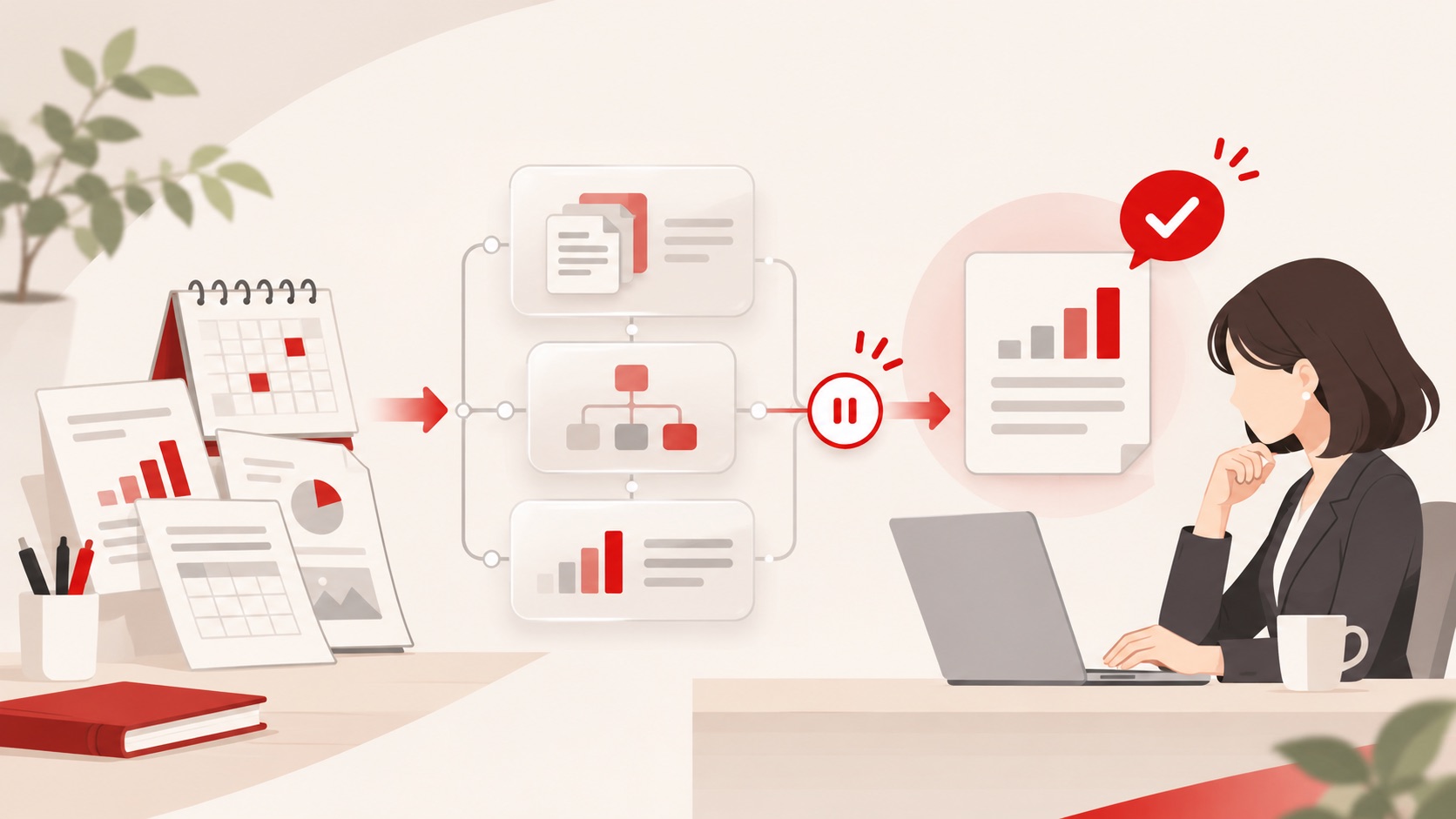
An illustration of implementation. Decide in advance which documents the agent may handle and where people will review its work. This image is an explanatory illustration.
AI Agent Implementation: Overview and Suitable Tasks
The process follows seven steps, from setting objectives to improving operations. The time required depends on data preparation, external system integration, and whether internal reviews are needed.
1. What Is an AI Agent?
An AI agent is a system that gathers information, makes decisions, uses authorized tools, and checks results in pursuit of a goal.
Unlike a one-off question to generative AI, it carries out multiple processes in sequence. While RPA primarily follows predefined rules, AI agents also retrieve information and make choices according to the situation.
Autonomy ranges from read-only access to actions in external systems. AI agents do not necessarily automate everything without human involvement; designs can retain human approval.
2. Identify Tasks Suited to Implementation
AI agents are suited to repetitive tasks with defined reference information and decision criteria, and results that can be verified.
Candidates include handling inquiries, gathering information, drafting documents, processing internal requests, supporting sales, and operating systems.
| Task characteristic | Well suited | Difficult to include in the initial scope |
|---|---|---|
| Repetition | Similar processes recur | Objectives and steps differ each time |
| Decision rules | Reference criteria can be documented | Objectives or correct outcomes are unclear |
| Data | Usable information is available | Its location or quality cannot be confirmed |
| Verification | People or systems can check results | Correctness cannot be verified |
| Impact | Errors can be corrected | Actions are irreversible or have a major external impact |
3. Clarify the Value Implementation Provides
The value of AI agents lies in their ability to improve processing speed, consistency of quality, and documentation of decision-making processes at the same time.
Evaluate not only processing time but also reduced variation between staff members and the accumulation of handling histories. Continuous service, including at night, and providing staff with information to support decisions also offer value.
-
Workload: Reduce repetitive work and backlogs
-
Quality: Maintain consistent responses and processing criteria
-
Speed: Shorten the time from research to execution
-
Risk: Track decision histories and exceptions
-
Employee experience: Reduce the burden of searching and transcribing
Evidence: The 2025 Survey on AI Agent Adoption in Companies surveyed 1,000 people at companies using generative AI in Japan in April 2025. It examined implementation and consideration stages, valued application areas, and expectations for adoption.
4. Understand the Implementation Process and Likely Time Required
It is easier to estimate the time required when you check each stage for data preparation, external integration, permission adjustments, and internal reviews.
-
Set objectives: Agree on the desired change in how the work is done.
-
Select target tasks: Define the scope the AI will handle.
-
Check risks and data: Determine whether the conditions for use are met.
-
Select an approach: Decide on a configuration that meets the requirements.
-
Prototype: Reproduce basic behavior in a limited environment.
-
Run a pilot: Evaluate KPIs and stop conditions.
-
Begin production operations: Put monitoring, shutdown, and improvement arrangements into operation.
Estimate based on what remains unprepared at each stage, rather than applying a fixed schedule. In particular, check reviews of authentication and external transmission separately from technical validation.
Decision Criteria and Prerequisites for AI Agent Implementation
Decide whether to implement based on evaluability, data, permissions, risks, and operational responsibilities as well as expected benefits. Avoid deciding solely on cost-effectiveness; also check the conditions needed to sustain production operations.
5. Define the Objective and Target Task in One Sentence
An implementation objective becomes measurable when you define in one sentence whose work will change, which task will change, and what the desired outcome is.
| Type | Objective statement |
|---|---|
| Good example | Change how sales representatives prepare for meetings so they can verify reference materials and supporting evidence |
| Vague example | Use AI to improve business efficiency |
Document start conditions, end conditions, exception handling, and the current person responsible in the workflow. Introducing technology must not become the objective itself.
6. Define Success Metrics and Stop Conditions in Advance
Pairing success metrics with stop conditions enables objective decisions about continuing, handing work over to people, or stopping.
| Success metric | Corresponding condition for stopping or review |
|---|---|
| Processing time and completion rate | Incomplete work or backlogs exceed acceptable limits |
| Number of corrections and reprocessing | The burden of corrections on users increases |
| Handoffs to people | Particular exceptions recur |
| User feedback | Quality or usability falls below the standard |
Record incorrect actions and failures as well as averages. Pairing metrics and conditions helps prevent a bias toward continuing based only on favorable results.
7. Check Data, Permissions, and the Usage Environment
Separating execution permissions into read, create, modify, send, and delete reduces the risk of granting excessive authority.
-
Check the location, quality, and update frequency of reference data.
-
Define confidentiality classifications, retention periods, and deletion policies.
-
Limit access permissions to those needed for each operation.
-
Check cloud usage conditions and whether external transmission is allowed.
-
Decide on authentication methods and how operation logs will be stored.
-
Apply rules for handling personal and confidential information.
During initial validation, prioritizing read access over sending or deleting helps limit the scope of impact.
8. Compare SaaS, Custom Development, and Integration into Existing Environments
Considering SaaS for standard tasks and custom design for tasks with many unique rules or complex integrations makes selection easier.
| Comparison criterion | SaaS | Custom development | Integration into an existing environment |
|---|---|---|---|
| Implementation speed | Easier to get started | Requires design work | Depends on the existing infrastructure |
| Fit with business needs | Primarily standard features | Easier to accommodate unique requirements | Easier to retain current workflows |
| Integration flexibility | Within the provider's supported scope | High | Depends on existing APIs |
| Maintenance responsibility | Shared with the provider | A broader scope falls to the implementing organization | Shared with existing operations |
| Ease of changes | Depends on product specifications | Depends on the design | Subject to existing constraints |
Compare RAG, authentication, system integration, and security management as well. Avoid choosing the same approach for every situation.
7 Steps to Implement AI Agents
Dividing implementation into seven steps, from setting objectives to production operations, and pairing actions with verification at each step makes the process easier to reproduce. Start small and expand permissions while recording the decisions made.
-
Step 1: Define objectives and responsible owners
-
Steps 2–3: Select target tasks and classify risks
-
Steps 4–5: Select an approach and prototype in a limited environment
-
Step 6: Measure benefits and failures in a pilot
-
Step 7: Move to production and continue monitoring and improving
9. Step 1: Define Objectives and Responsible Owners
Before starting AI agent implementation, clarify the business problem to solve and the people responsible for decisions about business processes, systems, and risks. If objectives and decision-making authority remain unclear, decisions are more likely to stall when specifications change, usage expands, or incidents occur.
Documenting the relationship between objectives, decision-makers, contact points, and incident owners makes it possible to quickly identify who should decide when changes or problems arise.
-
Define objectives: Clarify the tasks assigned to the AI agent, the departments that will use it, and the areas where people will make final decisions or give approval. Document both what will be automated and which decisions will not be delegated to the AI agent.
-
Assign responsible owners: Designate the business owner, system owner, user department contact, and risk decision-maker. If multiple departments are involved, clearly identify one person or organization with final decision-making authority.
-
Confirm communication and decision-making processes: Document the usual contact point, the approver for specification changes, and the first responder and escalation contact for incidents. It is also helpful to assign a backup decision-making role when the primary person is absent.
-
Check alignment with the implementation scope: Confirm that the objectives and division of responsibilities do not conflict with the data used, connected systems, or users' permissions.
-
When changing tasks or usage scope: The business owner reviews the impact and decides whether to allow the change.
-
When changing system integrations or permissions: The system owner reviews safety and the impact on operations.
-
When incorrect answers, a risk of information leakage, or unexpected processing occur: Escalate to the designated contacts, including the risk decision-maker.
10. Steps 2–3: Select Target Tasks and Classify Risks
Dividing work into input, judgment, execution, output, and exception handling lets you distinguish the responsibilities of AI and people.
-
Action: Break down the workflow and identify the stages handled by AI.
-
Verification: Ensure a third party can explain the respective roles of AI and people.
-
Action: Classify the impact of errors, irreversibility, confidentiality, and external impact.
-
Verification: Finalize prohibited operations, operations requiring approval, and handoff conditions.
11. Steps 4–5: Select an Approach and Prototype in a Limited Environment
Testing normal and error scenarios with limited data and permissions lets you identify design problems before connecting to production systems.
-
Action: Select the model, retrieval method, external tool integrations, and authentication method.
-
Verification: Record the reasons for adopting or rejecting options for each requirement.
-
Action: Run a PoC with anonymized or test data.
-
Verification: Reproduce normal scenarios, insufficient information, incorrect inputs, and integration failures.
12. Step 6: Measure Benefits and Failures in a Pilot
Recording incorrect actions, incomplete work, handoffs to people, and corrections lets you assess the burden that will arise in actual operations.
-
Action: Limit the users and record the predefined KPIs.
-
Verification: Explain whether a move to production is appropriate based on the conditions for continuing and stopping.
Evaluating only correct examples overlooks the burden of exception handling. Also record what users corrected and why.
13. Step 7: Move to Production and Continue Monitoring and Improving
Even after moving to production, you need to monitor execution logs and reevaluate whenever models, data, or business rules change.
-
Action: Gradually expand the users, target data, and execution permissions.
-
Verification: Test monitoring, notifications, shutdown, and rollback before the transition.
-
Action: Define procedures for handling inquiries and reevaluating changes.
-
Verification: Check whether staff can carry out the process from anomaly detection to recovery.
Implementation Precautions, Evidence of Reliability, and Consultation Preparation
To prevent implementation failures, check permissions, exception handling, handoffs to people, and clear identification of responsibilities as well as accuracy. Review causes of failure, how to assess reliable case studies, and consultation preparation as one connected process.
14. Check Common Stumbling Blocks
To prevent problems when implementing AI agents, check objectives, scope, permissions, handoffs for exceptions, and responsibilities before prototyping. Define decision criteria and responses for each checklist item, and reflect differences discovered during testing in the operational design.
Expanding permissions before objectives and responsible owners are defined makes it difficult to verify the validity of decisions and move a prototype into production.
-
□ Abstract objectives: Define the desired change in how work is done. Clearly specify the target task and the agent's role, such as performing initial inquiry routing.
-
□ Overly broad scope: Focus on a single workflow. Begin with a scope whose validation results can be checked, rather than targeting multiple departments or systems at once.
-
□ Unverified data quality: Investigate missing data and update status. For each reference dataset, check who updates it, how frequently, and whether it may be used.
-
□ Excessive permissions: Separate permissions and keep them to the minimum necessary. Distinguish operations such as reading, creating, updating, and sending, and do not grant unnecessary execution permissions during testing.
-
□ No exception handling: Decide who will receive handoffs. Define who will respond and how when the agent cannot decide, required information is missing, or unexpected input occurs.
-
□ Test conditions differ from production: Record the differences. Document differences in data, connected systems, permissions, users, and execution times, and recheck them when moving to production.
-
□ Unclear ownership: Identify decision-makers and operators. Separately name the people who make business decisions, change settings, and receive incident notifications.
-
□ No log retention: Keep histories of decisions and actions. Make inputs, reference information, actions taken, results, and whether a handoff occurred traceable.
-
□ No stop conditions: Test stopping criteria and methods. Confirm who stops the agent and which recovery procedure applies when signs of incorrect operations, unexpected processing, or integration errors occur.
After checking, divide unresolved items into those to resolve before prototyping, those to validate through testing, and those to prepare before production operations. Recording an owner and verification deadline for each item helps prevent issues from being overlooked.
15. Design Human Approval, Shutdown, and Handoffs
Require prior approval for high-impact or irreversible actions, and hand tasks over to people when there is insufficient information for a decision.
Human-in-the-loop is a design that incorporates human judgment into AI processing. Repetition of the same process and failures in external integrations should also trigger handoffs.
| Impact | Low autonomy | High autonomy |
|---|---|---|
| Low | Unattended execution | Review after execution |
| High, but correctable | Prior approval | Restrict permissions and require prior approval |
| High and irreversible | Human execution | AI use prohibited |
16. Check Case Studies, Evaluation Metrics, and Identification of Responsibilities
The more fully a case study documents the target task, evaluation method, results, constraints, and responsible owner, the easier it is to judge its applicability to your company.
-
Check the problem, target task, and system configuration.
-
Check the evaluation method, results, and constraints on application.
-
For numerical results, verify the measurement period, sample size, and comparison conditions.
-
Check the operating organization, business owner, and contact point.
-
Check the information update policy and publication date.
When reviewing published performance figures, check whether they are measured or projected, along with the measurement period and comparison conditions. Compare the target tasks and constraints instead of assuming your company will achieve the same results.
17. Organize Business Information Before a Consultation
Organizing the target workflow, data used, connected systems, prohibited actions, and expected outcomes makes it possible to assess feasibility concretely.
-
□ Target tasks and current workflow
-
□ Daily and monthly processing patterns
-
□ Data used and update methods
-
□ Systems to integrate
-
□ Prohibited operations and confidential information
-
□ Expected outcomes and KPIs
-
□ Desired operational setup
You do not need to finalize everything. If you understand the workflow and the problems you face, you can review the scope of AI agent development and implementation support and explain any undecided items during a consultation.
Frequently Asked Questions
18. Which Tasks Should We Start With When Implementing AI Agents?
Start with repetitive tasks that have defined decision rules and reference data, and whose results people can verify. Exclude irreversible operations and tasks with a broad impact from the initial scope.
19. What Is Needed to Move Beyond a PoC?
Before starting, define the conditions for moving to production, the person responsible for operations, integration requirements, execution permissions, and maintenance methods. Evaluate the burden of corrections on frontline staff and exception handling as well as accuracy.
20. What Requires the Most Attention Before Implementation?
It is important to keep execution permissions to the minimum necessary and establish a way to stop the agent and conditions for handing tasks over to people. Also review confidential information, external transmission, log retention, and the division of responsibilities.
Summary: Test on a Small Scale and Implement with Clear Decision Criteria
AI agents are suited to tasks that are repetitive and verifiable. The basic approach is to prepare data, permissions, KPIs, and a structure of responsibilities, then follow seven steps from limited validation to production operations.
The first step is to choose one target task and document its objective, data to be used, execution permissions, and success metrics. Defining stop conditions at the same time makes decisions about continuing or making changes easier.
If choosing an approach or deciding on system integrations is difficult, use your documented workflow to review the implementation support available and discuss the scope of support you need.
Sources and References
When deciding on AI agent implementation, it is important to cross-check adoption status, actual usage, and implementation challenges across multiple surveys. The following materials can help you verify evidence when considering implementation or explaining it internally.
Comparing sources with different survey populations, questions, and publication dates, rather than relying on a single survey, makes it easier to assess the evidence in the context of an individual company.
When reading each source, check the company sizes and industries surveyed, the definition of an AI agent, and categories such as already implemented or under consideration. When citing figures in internal documents, it is appropriate to also include the original survey conditions and the access date.
Adoption figures provide market context. Decide your own PoC pass criteria and whether to move to production through the business tests described above.
-
Cybozu's 2026 survey covered 551 companies with 1,000 or more employees, excluding the information and communications industry. It found that 16% had implemented AI agents company-wide, 30% had implemented them within specific departments or tasks, and 16% were running trials (PoCs). The combined 62% includes those running trials.
-
In the 2025 joint survey by BCG and MIT Sloan Management Review, 2,102 respondents from organizations across 116 countries and 21 industries reported that 35% had implemented AI agents and 44% planned to do so soon. These percentages were not obtained under the same conditions as those of your company in Japan.
-
Survey on AI Usage in Large Enterprises (AI Agent Usage)
https://cybozu.co.jp/it-foresight/research-whitepapers/2026-10-ai-research-2/ (accessed 2026-11-15) -
35% of Companies Have Adopted AI Agents, Outpacing Generative AI Adoption
https://www.bcg.com/ja-jp/press/27november2025-agentic-ai-blurs-line-tool-teammate (accessed 2026-11-15) -
2025 Survey on AI Agent Adoption in Companies
https://www.allganize.ai/ja/downloads/wp/ai-agent-survey-2025 (accessed 2026-11-15)
Referenced content may be updated or changed. When using it for implementation policies or investment decisions, check the latest text, research methods, and scope in the original sources linked above.